

By Onaho Pascal Oghenekaro
Sexual abuse is not always loud and obvious. The gore, violence, use of force, bodily defilement– these may not be present to the extent that makes the experience obvious, or may not even be present at all. Sometimes, sexual abuse could come in the form of smiles, assurance of safety, silence, and even show of affection, hiding in plain sight. At Aces Africa, we are aware that in order to effectively prevent abuse, we must go beyond the obvious and examine the true underlying vile pillar of abuse: Power
At its nucleus, sexual abuse (or any other abuse for that matter) is more about power. For any case of sexual abuse, you’d see that there is some form of an imbalanced power dynamics between the perpetuator and the victim. This power could be physical, financial, emotional, and even class or status. It’s about who has it, who does not, and how can the absence of this power in the victim be exploited. From a parent to a child, one sibling to the other, a teacher to a student, an employer to an employee, a caretaker to a child, and even sometimes, a teenager to a house helper and vice versa(Yes! as incredulous as this last example sounds, it happens and is not so uncommon), the underlying premise remains the same: That is, there is an imbalance of power that leaves one party, the victim, vulnerable.
The danger becomes even more insidious when abuse puts on an invisibility cloak, masking itself from the victim and those around them. And this is especially prevalent in a society like Nigeria and most of Africa, where authority and hierarchy are deeply rooted. And because many sexual abuse do not fit the typical script often portrayed in movies, victims could fail to recognize when they are being abused. They might feel a sense of discomfort, delirium, or feel gaslighted. However, because there is no violence or no use of outright coercion by the perpetuator, the victim (and others) might not label it as abuse.
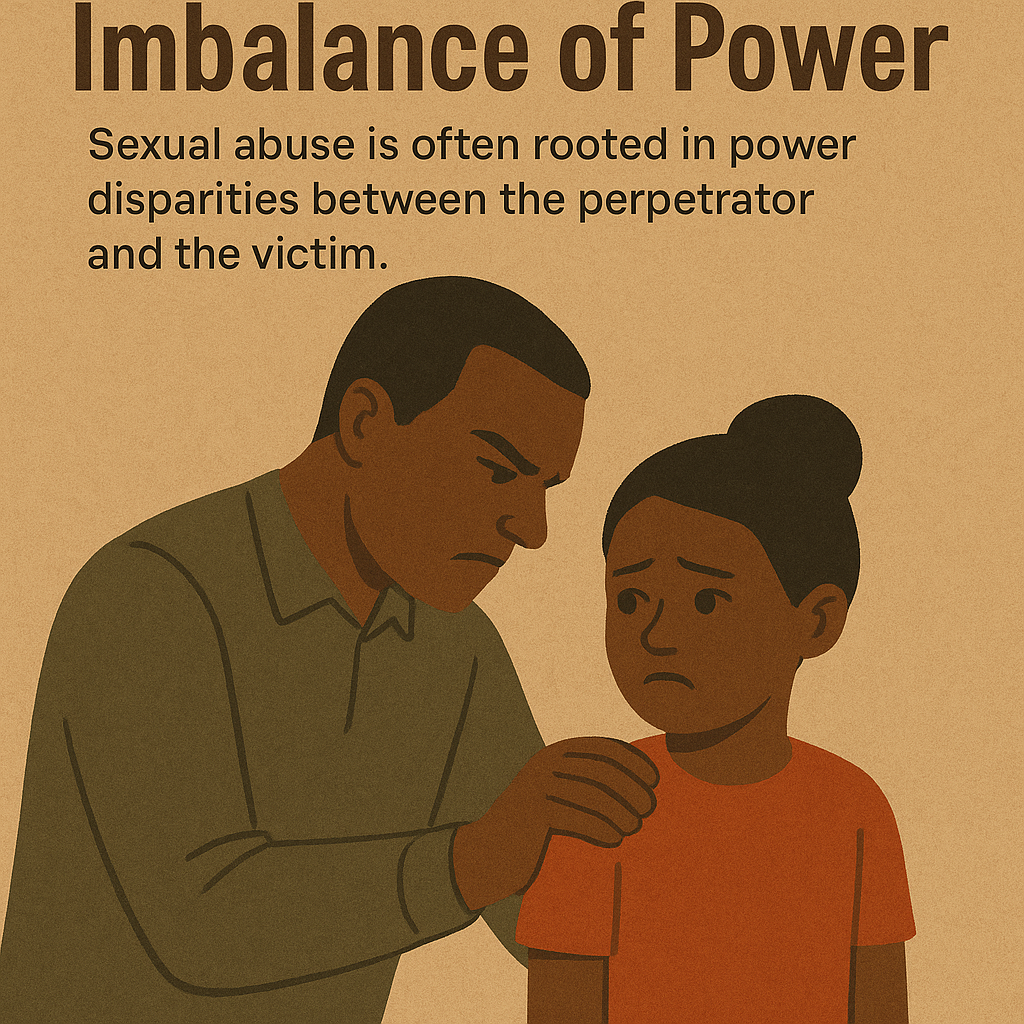
In our society, when we talk about abuse, we fail to talk about power dynamics. This could be as a result of lack of awareness of this contributing factor, or perhaps people do recognize it, but do not consider it important enough. Nevertheless, we unknowingly allow silence grow where there should be questions. A child might not know they can say no to an uncle. A student might think their teacher’s special attention is complementary. A domestic helper or nanny might believe their lack of options means they have no right to refuse. This is why we must embolden ourselves and the society with the right information and knowledge on sexual abuse and how to recognize it. It goes beyond teaching children “good touch” and “bad touch”. We must teach context, boundaries within strangers, families, workplaces, schools, churches. We must also teach that abuse is not just about the action carried out, but also who has the power to do it and whether or not it can be refused without consequences.
At Aces Africa, we are committed to challenging these silences. We believe the prevention of sexual abuse starts with awareness and recognition of the different pattern and forms it takes.
So next time you talk or hear about abuse, don’t just ask “What happened?” or “Why did you not refuse?”
Ask: “Who had the power in that situation, and what did they do?”